Table of contents
Paris has never lacked for hotels, but the quiet shift now reshaping the city’s hospitality scene is less about rooftop bars and more about what lies behind the walls, in the fabrics, the lighting, and the daily logistics of running a building responsibly. In the 13th arrondissement, a district long defined by its mix of student life, modern towers, and street art, Hotel Urban Bivouac Paris is part of that movement, positioning itself as a 3-star address that pairs design choices with practical access to public transport, and a neighbourhood that rewards curious travellers.
In the 13th, design meets everyday Paris
Forget the postcard Paris for a moment. The 13th arrondissement is where the city’s day-to-day reality unfolds, with families doing groceries on Avenue d’Italie, students cutting through side streets toward university campuses, and office workers filling cafés near Place d’Italie, and it is also where some of the capital’s most visible contemporary art lives in plain sight. The district’s “Street Art 13” route, promoted by local authorities and cultural organisations, has turned residential façades into open-air galleries, with monumental murals by international artists that have become a draw in their own right. It is a Paris that feels lived-in rather than staged, and that is precisely why travellers increasingly choose it, especially as central neighbourhoods struggle with density, rising prices, and the fatigue of overtourism.
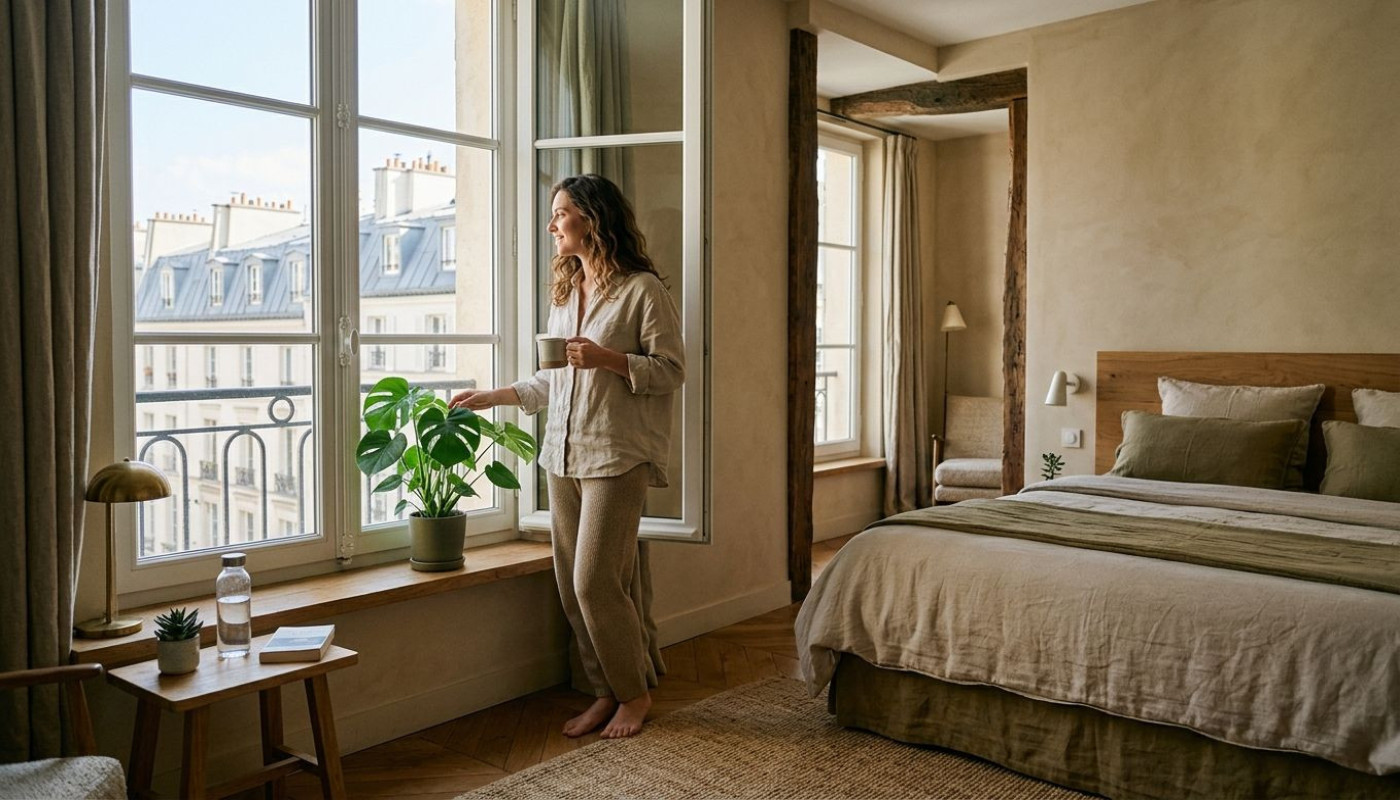
Hotel Urban Bivouac Paris leans into that local texture instead of trying to compete with the gilded codes of the 8th or the clichés of the Latin Quarter. As a 3-star hotel in Paris’s 13th, it sits in a part of the city where design can be more experimental and less ceremonial, and where guests often want a smart base rather than a theatrical experience. The “bivouac” idea, borrowed from the world of travel and temporary shelter, translates here into an aesthetic that favours warm materials, practical comfort, and spaces that feel considered, not overproduced. Sustainable design, in this context, is not a slogan plastered onto a lobby wall; it is the discipline of making rooms that last, resisting the throwaway trends that force frequent refurbishments, and choosing durable elements that reduce waste over time.
This is where the conversation about sustainability in hotels is changing. In France and across Europe, the industry faces a tightening regulatory and reputational landscape, from energy performance expectations to a growing guest demand for transparency, and the most credible responses tend to be the least flashy. A hotel can advertise towel-reuse cards all it wants, yet the bigger impact often comes from decisions guests barely notice, such as efficient heating and cooling strategies, thoughtful lighting, or limiting unnecessary single-use items in favour of refillable systems. Design, when it is done well, becomes a form of quiet infrastructure, and travellers feel the result in the ease of the stay: a room that works, a space that breathes, a building that does not fight its own footprint.
Why public transport now defines a “good” stay
Convenience has become a sustainability issue, and Paris is a textbook case. The city’s public transport network is among the densest in Europe, with the Métro, RER, tramways, and buses forming a system that makes cars optional for most visitors, and the official policy direction is clear: fewer private vehicles, more shared and low-carbon mobility. For travellers, that means the definition of a well-located hotel is shifting. It is no longer only about being able to walk to the Louvre in ten minutes, it is about being able to move through the city efficiently without defaulting to taxis, and to reach airports, train stations, and business districts with minimal friction.
Hotel Urban Bivouac Paris benefits from that logic because it is close to public transport options that connect quickly to the rest of the capital, including major hubs that matter in real itineraries: a morning meeting across town, an evening show, an early train, a late flight. In a city where traffic congestion is a daily reality and where ride-hailing costs can spike during peak hours, proximity to the network is not a minor perk, it is a budget and stress reducer. It also changes how guests use the city, because when the Métro is within easy reach, travellers are more likely to explore beyond the centre, to eat in neighbourhood restaurants rather than defaulting to tourist corridors, and to distribute their spending in ways that benefit a wider range of local businesses.
The link to sustainable design is more direct than it seems. Location and mobility decisions shape the carbon footprint of a trip, and accommodation that supports low-emission movement plays a role in that equation, even if it does not appear on a room keycard. Tourism researchers and policy-makers increasingly emphasise that the largest share of travel emissions often comes from transport, particularly flights, yet local mobility still matters because it is the daily habit that can either reinforce or reduce reliance on cars. A hotel that makes it easy to use public transport, and that communicates those options clearly, is aligning guest behaviour with broader urban goals, and in Paris, where the city continues to reallocate street space toward pedestrians and cyclists, that alignment is becoming part of what modern hospitality looks like.
The 3-star category is quietly changing
Who said 3-star meant “basic”? In Paris, the middle of the market is where much of the real innovation is happening, partly because it has to. High-end hotels can absorb costly renovations and heavy staffing models, budget properties can compete primarily on price, but 3-star hotels sit in a zone where guests expect comfort, style, and reliability, and they also expect value, meaning operators must make smart choices that hold up over time. That pressure has produced a new kind of 3-star offer: less uniform, more design-aware, and often more serious about operational efficiency, because waste is expensive and inefficiency shows up quickly in the numbers.
Hotel Urban Bivouac Paris illustrates that shift by offering a 3-star experience anchored in the realities of contemporary travel, from short business stays to long weekends and family visits. The point is not to mimic luxury, it is to deliver what travellers actually use: a room that feels calm and well-built, a good night’s sleep, and a setting that makes it easy to navigate the city. Sustainable design fits naturally into that promise because it rewards durability and reduces the need for constant replacement, and while guests may not ask about the lifecycle of a chair or the sourcing of a textile, they do notice when a place feels coherent, when it is well maintained, and when it avoids the fatigue of disposable décor.
There is also a competitive truth that many hoteliers now acknowledge, even if they phrase it differently: travellers are more sceptical. They read reviews closely, they compare photographs, they notice inconsistencies between branding and reality, and they are increasingly alert to “green” claims that sound vague. Credibility, therefore, comes from specifics: from visible choices like reduced plastic, practical information about getting around without a car, and the general impression that the property is run with care rather than shortcuts. In that environment, the 3-star category becomes a proving ground, because it must deliver tangible quality without the cushioning effect of luxury pricing, and it must do so in a city where operating costs, from energy to labour, remain high.
A neighbourhood that rewards curious travellers
Want Paris, not a theme park? The 13th arrondissement invites a different rhythm. Beyond the headline murals, the area’s appeal lies in its mix of cultures and uses: residential streets, Asian supermarkets and restaurants around the Triangle de Choisy, contemporary architecture near the Bibliothèque François-Mitterrand, and pockets of older Paris that survive between modern developments. It is a district where visitors can eat exceptionally well without chasing reservations weeks in advance, and where an evening walk feels more like living in the city than consuming it. For travellers who have already “done” the monuments, or for first-timers who want to balance classics with something more grounded, it is an increasingly logical base.
Staying at Hotel Urban Bivouac Paris places guests in that environment while keeping the rest of the capital within easy reach via public transport, and that combination is part of what makes the sustainable-design conversation feel relevant rather than abstract. Sustainability, after all, is not only about materials and energy, it is about the shape of a trip: how far you move, how you move, where your spending goes, and whether your presence in a city adds strain or spreads benefit. Choosing an arrondissement outside the most saturated zones can be a small but meaningful act of deconcentration, helping reduce pressure on the neighbourhoods that have become tourism bottlenecks, and supporting the everyday commerce of districts that still function primarily for residents.
The practical payoff is immediate. A hotel in Paris’s 13th can offer a calmer base at night, often with more space than similarly priced options in hyper-central areas, and it can shorten the time spent stuck in traffic, which is rarely anyone’s idea of a good holiday. The experiential payoff is just as real: mornings that start in local bakeries rather than queues, evenings that end without fighting crowds, and a sense that Paris is still a city with many centres. That is the silent revolution of sustainable design in hospitality, not a dramatic reinvention, but a series of decisions that make travel lighter, smoother, and more respectful of the urban fabric.
How to plan it, and what to budget
Booking early remains the simplest lever. In Paris, prices move fast around trade fairs, school holidays, and major events, and 3-star properties that balance design and transport access can fill quickly, so comparing flexible versus non-refundable rates often makes a bigger difference than hunting for last-minute bargains. For travellers focused on public transport, budgeting should include a multi-day pass or stored-value options, because relying on taxis in a congested city can quietly inflate the overall cost of a stay, and it also undercuts the low-carbon advantage of a well-connected location.
As for financial “aids”, Paris does not offer a universal tourist subsidy, but visitors can reduce costs through practical tools: discounted museum passes when they match the itinerary, advance train tickets for airport and intercity connections, and, for eligible travellers, rail and coach youth or senior reductions. In that framework, a 3-star base like Hotel Urban Bivouac Paris, in the 13th arrondissement and close to public transport, becomes a straightforward equation: fewer transport headaches, controlled daily spending, and a stay that aligns comfort with the quieter priorities shaping modern travel.
On the same subject

Step Into Digital Nomadism: How To Make Money Online? From Bali To Berlin
Step Inside A Hotel In Paris Where Heritage Meets Tomorrow’s Trends

Hotel In Paris: Where Design Meets History In The City Of Light
Hotel In Paris: Where Old-world Elegance Meets Modern Traveler Demands
Hotel In Paris Guests Are Redefining City Escapes—here’s What They Want Now
Hotel In Paris: Reinventing The Art Of Urban Hospitality

Exploring Sustainable Travel Options For Your Next Hotel Stay In Paris
How To Discover Hidden Gems Among Hotels In Paris?
Exploring Eco-friendly Options For Staying At A Hotel In Paris
How To Find Eco-friendly Accommodations In Paris
A Guide To Finding Family-friendly Accommodations In Paris

Exploring Unique Boutique Hotel Experiences In Paris

Exploring Unique Museums: How Themed Attractions Can Boost Local Tourism

Undiscovered Gems: Exploring the Hidden Corners of Eastern Europe
